
Care homes (EMS)
Supporting teams and vigilance, with an improvement approach built over time.
Cookies and measurement
With your consent, we use Google to measure whether a visit leads to a presentation request. Google then sets cookies and may process this data outside Switzerland. Without consent, nothing is sent to Google. Learn more
Institutions & professionals
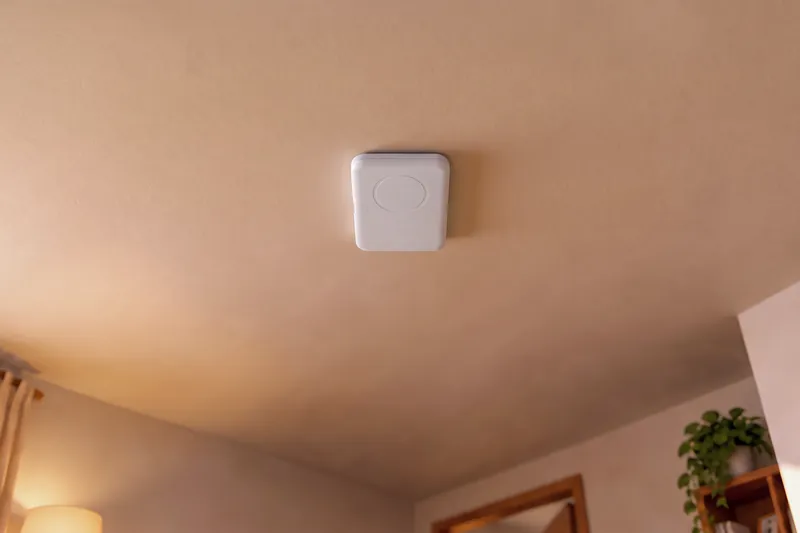
Elys detects falls and abnormal positions in equipped bedrooms and spaces, and notifies the carers designated by the institution. No camera, no microphone and no device for residents to wear.
Technology sheds light. People decide.
The designated professionals receive the alert in the app, with the location concerned. If nobody reports taking charge, Elys also uses SMS and automatic calls to the selected numbers and continues the follow-up reminders. “I’m on it” reports taking charge; “Resolved” marks the reported closure. The organisation of the response remains that of your institution.
Technology tried and tested in care settings
The sensor technology selected for Elys has already been the subject of a documented deployment in a care home for older people in Europe. Elys integrates it into a platform developed by Méditrine SA for the needs of care teams: an overview of the equipped spaces, located alerts, follow-up reminders and a timeline of the declared responses.
This European reference concerns the sensor technology; it is not a customer reference or an Elys deployment.
An overview of the equipped rooms, alerts placed in their context and a timeline of the declared actions. The care staff designated by the institution receive the notifications; as long as none of them has confirmed they are taking charge, SMS messages and automatic calls continue the reminders to the registered numbers.
A declaration of taking charge is not proof of presence on site.
Every event and every declared action is time-stamped and kept in a secure history, designed so that any change is detectable.
Data from the Elys application is stored in Switzerland, with Infomaniak.
Elys provides reference points; the teams give them meaning.
Useful information does not stop at a notification. Over time, documented events and accessible observations can inform discussions between professionals: better understanding situations, identifying needs to examine and looking for relevant adjustments. Elys does not measure the individual worth of a carer and does not replace professional analysis.
Tailored
Every institution has its own way of working, its own spaces and its own priorities. Before talking about installation, we suggest a conversation to look together at the most relevant configuration, the operating arrangements and, if necessary, the options for interfacing with your existing systems.
Organisation of units, day and night requirements, bedrooms and communal areas: we begin by understanding the way you work and your constraints.
Rooms and zones to equip, useful alerts, recipients, connectivity and installation conditions.
Nurse call, IT tools, security requirements: we assess with your teams what is feasible. No interface is promised before this study.
Scope, access roles, support and price: a written proposal, on quotation, adapted to your institution.
Validation of the layout, settings and team training, then adjustments based on your feedback.
Relevance of alerts, internal rules, desired adjustments: the follow-up is defined with each institution and includes at least one on-site visit a year for care homes, under the agreed contractual terms.
Today’s collaboration will bring tomorrow’s peace of mind.
Let’s look at your projectSupporting teams and vigilance, with an improvement approach built over time.
Preserving independence, respecting privacy and offering complementary vigilance.
Assessing the needs of the teams and the scope of a possible project with the professionals concerned.
Discovering a complementary tool to present, where relevant, to the people they support and their loved ones.
On quotation, depending on the number of people supported and sensors required, and on the agreement reached between Méditrine SA and the client.
A specific proposal, assessed with each facility.
Security measures and access rights are defined according to the service and the contract.
No. Elys provides complementary vigilance in the equipped rooms. How it might fit with existing processes needs to be examined with the institution.
No. Elys is designed for vigilance and for following up events, not for assessing individual staff members. The platform may record the professional identity of the person who acknowledges an alert or declares that they are taking charge of it, together with the times involved, in order to document how it was handled. Access to these records and their use must be defined and governed by the institution, in line with the applicable data protection and employment rules.
It depends on the number of residents and sensors, the rooms, the installation conditions and the support chosen. We draw up a tailored written proposal.
It depends on the equipped rooms and the configured zones: from 20 to more than 150 habits to explore, depending on the configuration. A bedroom with a configured bed zone provides night-time indicators, such as getting up; a bathroom, a kitchen or a living area add their own indicators of presence, duration and comings and goings. These indicators describe what is observed in the equipped spaces; interpreting them remains a matter for professionals.
Our testing continues. Find out how we test Elys, without confusing simulated tests with clinical results.
We too will grow old. The way we prepare living spaces and working conditions for teams today helps to shape the care we will wish for tomorrow.